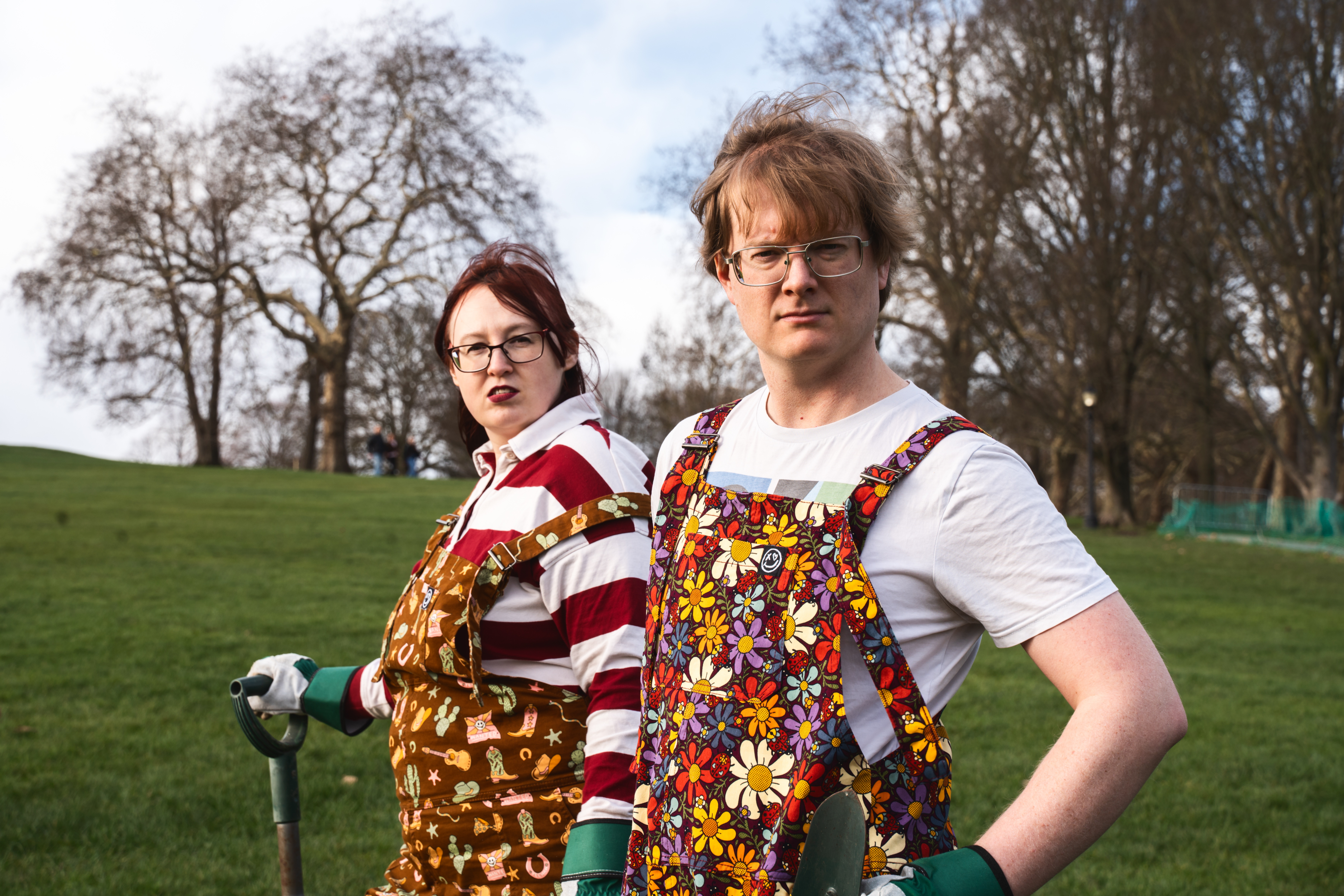
Joel X Eleanor are a London-based power alternative duo: Eleanor, a Hungarian-born contralto raised in Transylvania with a poet for a grandfather and a family steeped in literature; Joel, a Scouser who grew up in remote Myanmar without electricity and didn’t encounter pop music until he was eleven. Both autistic and intensely detail-driven, they spent three years building a cult following in London’s underground scene as Sweet Anna before stepping forward under their own names. Their double single “Garden Plot / Something Strange” is out now.
They answered our questions together — splitting them naturally, answering as one voice where it made sense and as two where it mattered. An album follows in autumn 2026.
“Now that we’ve been writing together for a few years, it is more of a shared language. Joel knows which tunes I’ll like the most, and we have a radar for phrases that are too twee or just plain silly. We’re ruthless — even if we had already put some work into it.”
— Eleanor
EV
Joel, you grew up in remote Myanmar without electricity and didn’t encounter pop music until you were eleven. Eleanor, you were raised in a Hungarian family steeped in literature and music. When you first started writing together, was there a moment where those two wildly different sonic upbringings actually collided on a track — and what happened?
EL
I think the main collision, if you really want to call it that, came at the very beginning, when we were still trying to figure out our genre. I wanted to be loud, heavy, mean, whereas Joel was playing jazz chords to my hard rock ideas. He wanted our music to be melodic, more nuanced if you will. He’s also a naturally sunny presence. Eventually we found a happy medium, and I think it really does come out on “Garden Plot.”
Loud, heavy, and mean meeting jazz chords and melodic instinct — the happy medium they found is the gap those two descriptions leave between them. Both tracks on the double single live in that exact space.
EV
You built a cult following in London’s underground scene for three years as Sweet Anna before stepping forward as Joel X Eleanor. What was it about that reinvention that felt necessary — was Sweet Anna a chapter that ran its course, or was Joel X Eleanor always the destination you were moving toward?
J+E
In hindsight Joel X Eleanor was always the destination, but we were misguided at first and really clung to the idea of a band, when really we were always the people writing the songs, marketing ourselves and just being the face of the operation. After several false starts with different people, it felt like a necessity if we wanted our music to survive.
EV
Both of you are autistic and describe yourselves as intensely detail-driven — “every lyric, melody and sound must earn its place.” In practice, what does that actually look like in the room? Is there a lot of conflict before something earns its place, or does the precision feel more like a shared language between you?
EL
Now that we’ve been writing music together for a few years, it is more of a shared language. Joel knows which tunes I’ll like the most, and we have a radar for phrases that are too twee or just plain silly. It took a while to get comfortable, but now we’re ruthless, even if we had already put some work into it. If at any point, a song is not good enough to stand on its own, it will be scrapped. If there was a brilliant part in it that should become a song, it might get a complete rewrite!
The willingness to scrap a song that already has work in it — to treat sunk cost as irrelevant if the result isn’t good enough — is rarer than it sounds. It’s also probably why the double single sounds as finished as it does.
Eleanor: “I like dark and obsessive.” Joel: “Deliberate — because I knew she’d like it.”
— On Joel’s production reframe of “Garden Plot”
EV
“Garden Plot” started as Eleanor writing a romantic response to Joel asking for flowers — and then Joel’s production turned it into something darker and more obsessive. Eleanor, when you heard what he’d done to the track, what was your first reaction? And Joel, was the reframe deliberate from the start or did it emerge from the production?
EL
I like dark and obsessive.
JL
Deliberate, because I knew she’d like it.
EV
The Hungarian love poem by Attila József that whispers through “Garden Plot” — “Bite me, bite me — or I’ll bite you” — is a striking line to bury in a song about romantic fixation. Eleanor, what drew you to that poem specifically, and how intentional was it to leave it as something most listeners won’t immediately catch?
EL
We like slipping Hungarian lines into our songs (and we’re committed to releasing a song with Hungarian lyrics on each album), and since he’s my favourite poet, it was an easy connection to make. The whisper was intentional — it’s more fun if you let people’s ears perk up!
A whispered Attila József line as an Easter egg for Hungarian speakers — and a commitment to include Hungarian lyrics on every album. The multilingual texture isn’t decoration; it’s a structural part of who Eleanor is as a lyricist.
EV
Recording part of “Garden Plot” at Joel’s grandmother’s house in Birkenhead over Christmas, using a decorative aluminium cone tree as a percussion instrument — that’s a very specific creative decision. How much of your recording process is that kind of opportunistic, use-what’s-in-the-room thinking versus planned studio work?
EL
Opportunistic, I like the sound of that! I’d say maybe 95% planned, 5% opportunistic. For “Garden Plot,” we knew we wanted some extra percussion, so technically it was planned, but then the specific instrument presented itself and we just took it! But in general it’s small details that change during the recording process — for example, some words just don’t sound good, and it’s the shape of the word, the pitch and the specific cluster of consonants clashing, and it doesn’t become obvious until you try to get a perfect take, but those kind of last-minute changes are more often the exception, not the rule.
“I tried to make it so that another woman would be comfortable singing it to her own boyfriend. I think you always have to be thinking about that when you’re writing lyrics — would a total stranger be happy to sing this?”
— Joel on writing “Something Strange” for Eleanor
EV
“Something Strange” covers the intimacy of sharing your life — and your bed — with someone for the first time. Joel, you wrote most of that one. How do you write vulnerability that specific without it feeling like oversharing — where’s the line between lyrical intimacy and something that becomes too private to put in a song?
JL
We once had a guitarist who wrote a song naming a specific boy, and talking about the specific things that they like to do with each other’s bodies — obviously Eleanor refused to sing that. On the other hand, when I wrote “Something Strange” for Eleanor, I tried to make it so that another woman would be comfortable singing it to her own boyfriend. I think you always have to be thinking about that when you’re writing lyrics — would a total stranger be happy to sing this?
The universality test — would a stranger be happy singing this? — is a more precise and useful framing for lyrical intimacy than most songwriting advice manages. It solves the oversharing problem not by pulling back but by writing toward something true enough to be shared.
EV
Your reference points are Radiohead, Muse, The Smashing Pumpkins, Red Hot Chili Peppers — but you also cite London’s modern jazz movement. Those two worlds don’t usually end up in the same room. Where does the jazz actually show up in the music — is it harmonic, structural, something in Eleanor’s vocal approach?
JL
I don’t think that’s true about rock and jazz music not ending up in the same room. Remember when Ezra Collective were nominated for the “alt-rock” category at the BRIT awards? Over the years, jazz and rock music have been fusing more and more, especially, I think, in London. The specific influence from the London jazz movement was the deep bittersweet chords, clean percussive arpeggio in the high register of the guitars, and moving basslines. The harmonies also drew a lot of inspiration from songs by Kokoroko.
EV
You have a show at HMV Canterbury in June and Spectrum Festival in Matlock in September — two very different environments. How does a Joel X Eleanor live set translate the density of the recorded work? Does the intimacy of the studio version survive the stage?
J+E
We’ve been working a lot on making our stage performance stand out. When HMV booked us we didn’t even have a drummer for our shows, so it was going to be unplugged, pared back. Now we have a drummer — Flora — and she’s going to play a cajon, with Joel playing an electric acoustic guitar. Joel and Flora have also started practicing doing harmonies for our stage shows so that our music can still sound layered, just the way it does on the recordings (although sadly we can’t replicate 7 guitars at the same time on stage!). For shows at larger venues and festivals, we’ll be using a full drum kit, Joel’s Jazzmaster, and a complex web of wires and pedals to split the signal into the guitar and bass amps, plus all our voices. It’s really exciting!
EV
You’ve described yourselves as soulmates building something meant to bring colour, drama and fun to modern music. By the end of 2026 — where does Joel X Eleanor need to be, and what does the next body of work look like?
J+E
By the end of 2026: Hopefully on national radio and on the mind of the public! We’ve got an album coming up in the fall. It’s going to talk about a lot of things that are important to young people today — you’ll see.
An aluminium cone Christmas tree used as percussion. A whispered Attila József line as a secret for Hungarian ears. A universality test for intimate lyrics. A duo built in a grandmother’s house in Birkenhead and an AirBnB in Derby. The album in the fall will tell us what all of that adds up to — and “you’ll see” is exactly the right thing to say about it.