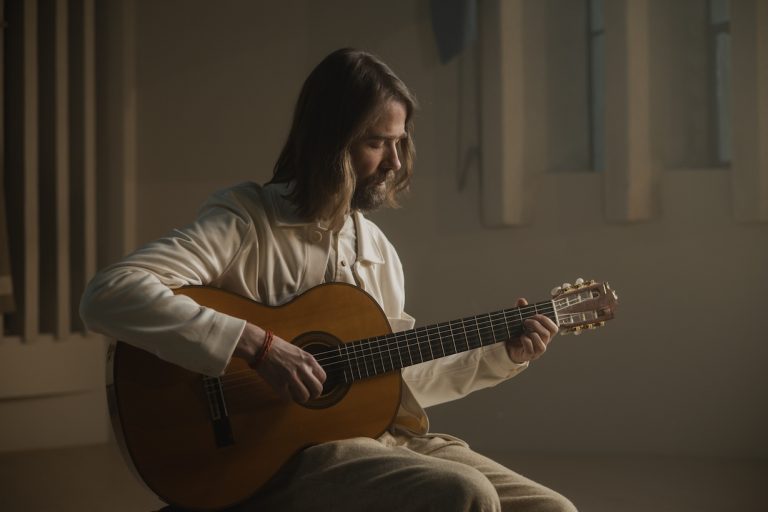
Nick Swettenham’s father Geoff and uncle Pete were founding members of Grapefruit — the Apple Publishing band named by John Lennon after Yoko Ono’s book, introduced to the press by Lennon himself at a launch party attended by McCartney, Ringo Starr, Brian Jones, Donovan, Cilla Black, and reportedly Jimi Hendrix. Their debut single “Dear Delilah” hit #21 on the UK Singles Chart in 1968. Lennon and McCartney produced their follow-up. It’s one of the more remarkable footnotes in British rock history — and Nick grew up with it as simply the texture of family life.
Now, with his fifth single Summer, Nick is building his own thing under the Model Citisin name — an indie rock project rooted in emotional restraint, melodic precision, and a Beatles-adjacent ear for the moment when a song stops being a composition and starts being a feeling. He answered our questions the same week his second child was due. The answers arrived two days later. We’re glad they did.
July
Next Single: Letters
“Let’s almost sing it like you don’t care. So I sang it as effortlessly as possible and it hardly needed a vocal correction.”
— Nick Swettenham, Model Citisin
EV
Your father Geoff and uncle Peter were founding members of Grapefruit — signed by The Beatles, named by John Lennon in 1968. Growing up with that as the backdrop of your family’s story, how did it shape the way you understood music and what it meant to pursue it seriously?
NS
In lots of ways yes, because even though Grapefruit was a short-lived career for my dad, the music was always there in the house on CD and now to stream so it never dies and they remained a point of interest for authors writing about The Beatles. But at the same time no, because my dad at this point was an accountant and he hadn’t been in an originals band since the late 60s. He did covers bands, he really enjoyed it and he took that seriously but he never installed anything in us like to go out and become professional musicians. He wasn’t into songwriting so that was really more from me listening to bands like R.E.M, Oasis and Radiohead.
The Grapefruit story is remarkable by any measure — a press launch attended by three Beatles, the Rolling Stones, Donovan, Cilla Black, and Jimi Hendrix; a debut single that cracked the UK Top 25; songs produced by Lennon and McCartney. But family mythologies have a way of becoming ordinary through proximity, and Nick’s account of it has the ring of a man who grew up understanding it was special without being consumed by it. The songwriting impulse, when it came, came from somewhere else entirely.
EV
Grapefruit has largely been lost to mainstream music history. Did you grow up aware of the full weight of what they were part of, or did that understanding come later — and has it changed how you think about your own work’s legacy?
NS
In lots of ways we did because it’s the Beatles you know. They’re legends and no one’s bigger than The Beatles so of course we grew up thinking this was special but because my dad wasn’t in the business anymore we weren’t apart of that culture. He didn’t have any celebrity friends. He was a normal guy so at the same time we kind of aware that it was very much a fleeting thing and he had a new life after that.
“My dad was an accountant. He didn’t have any celebrity friends. He was a normal guy — and at the same time we were aware it was very much a fleeting thing and he had a new life after that.”
— Nick Swettenham
EV
“Summer” was originally recorded instrumentally a few years ago. Then came the hearing damage. Walk us through what it was like to discover that — and what the process of reimagining the vocals actually looked like once you decided to go back to the track.
NS
So I wasn’t aware that I had hearing damage when I went to record the song originally but I was having issues singing in key. I had a singing teacher briefly and she told me: “Nick you have a great range but it’s almost like you’re hearing the songs wrong.” I went to record the vocals but I just couldn’t sing the song in tune. My producer tried to get something else out of me which was a bit more upbeat but it just didn’t feel right. Then as time went on I thought, just let the song go, cause it’s a very mellow track, even though it has a driving beat. I said, let’s almost sing it like you don’t care. So, when I recorded the vocals a few months ago, I sang it as effortlessly as possible and it hardly needed a vocal correction. It’s come out pretty much how I imagined it. Some people may feel it needs to be more upbeat and a bit more energetic vocally but I’ve got plenty of songs like that. So actually I think as it’s a summer evening song it’s perfect and you can almost just chill back and relax with it.
The phrase “sing it like you don’t care” might be the most concise production note in recent indie rock memory — and the fact that it came out of genuine difficulty rather than stylistic calculation gives Summer a particular kind of authority. The restraint in the vocal isn’t an aesthetic choice layered on top; it’s the song finding its own solution.
EV
Permanent hearing damage in one ear is a profound thing for any musician to navigate. Has it changed the way you write, record, or hear music in ways that have surprised you — either negatively or unexpectedly positively?
NS
Unfortunately it’s pretty much all a negative physically as the low notes in my left ear have completely gone so I’ll definitely never be a bass player — that’s for sure! Sometimes songs and notes sound completely out of tune and I can’t tune a guitar by ear anymore. There’s a constant humming in my ear and I have non-stop brain fog. But you should always turn a negative into a positive so I’ve used it as motivation to keep pushing harder.
“I’m pretty sick of Rock ‘n’ Roll taking a back seat and it needs to be back on top where it belongs. If I can be even a small cog in the wheel to help that then I can be proud.”
— Nick Swettenham, Model Citisin
EV
The press materials describe “Summer” as sounding like Fleetwood Mac and The Smiths had a lovechild. Where do you hear each of them in the track, and are those conscious reference points or did someone else make that connection after the fact?
NS
It has a very “Mick Fleetwood” beat. It’s flat but it’s solid and has purpose. It’s definitely a more Stevie Nicks style song. As for The Smiths, it’s the guitar melodies, particularly on the refrain — so more Johnny Marr than Morrissey.
It’s a precise breakdown — and accurate. The rhythm has that Fleetwood Mac quality of serving the song without showboating, and the guitar melodies carry the Marr DNA of making a riff feel like an emotion rather than a technique. That it came together from a track that spent years in limbo makes the clarity of those reference points all the more striking.
EV
This is Model Citisin’s fifth single. Looking at the arc from the first release to “Summer,” what has changed most — in the music, in the process, in what you’re trying to say?
NS
The song itself doesn’t have any real hidden meaning but there’s definitely a love and a bond between two people in there. Yeah it’s about summer but there’s that optimism and hope that I feel needs to be in the majority of songs.
EV
You and your brother Jamie make music together, which puts you in a long line of famous musical siblings — and also in the same lineage as your father and uncle. What does it actually feel like to be in a band with family, day to day in the room?
NS
With us Swettenham boys it works really well because even though we are a band, it’s my songwriting project and I’m doing all the investment, production etc. So we only rehearse once a week at present and he’ll come in to record the drums. I’m about to have my second child but as time goes on we’ll be playing live more and more. I thought producing my brother could cause issues but we actually work great together so it’s just fun. Maybe the red wine helps!
Geoff and Pete Swettenham played together in Grapefruit. Now Nick and Jamie carry the Swettenham name into another generation of music — a continuity that’s as much about temperament as genetics. The red wine probably doesn’t hurt.
EV
The band is based in the UK and operating largely independently. What does the landscape look like from where you’re standing right now — is it harder or easier than you expected to get music heard, and what’s working?
NS
So we started out in 2010 with an old band of ours. We were doing the gig circuits in London like Scala, The Waterrats, Half Moon in Putney etc but this was when the industry was changing so much but before self-publishing was a thing. It was disheartening and the band ended up splitting. I had a long break but always kept writing. Fast forward and I’m starting to figure out how to use the digital and social media era to my advantage. I have around 70 songs either finished or in the works so it’s just a case of having a consistent plan and trying to separate my creative brain from my business brain. I essentially do everything from the songs to producing, socials, promoting, advertising etc. To be successful as an independent artist these days you have to accept that this is down to you and no one else. Work ethic is vital!
Seventy songs. The catalogue exists; the architecture around it is being built piece by piece. It’s a model that’s become increasingly familiar in independent music — deep creative reserves meeting the slow, grinding work of building an audience without institutional support. Nick has clearly made peace with the reality that both halves require full attention.
EV
“Summer” as a subject — late evenings, a specific emotional temperature — feels very deliberate. What draws you to that particular season, and is there a time of year or a time of day where you feel most like a songwriter?
NS
Oh god no haha. Songs just fall out of the sky and it’s up to me to catch up. This could be any time of the day or night. I’ve written a few songs in my sleep where the chorus is just there. Our 3rd single “Who You Are” being the best example.
There’s something fitting about that — an artist who can’t tune a guitar by ear anymore, writing melodies in his sleep. The songs aren’t coming from the head. They’re coming from somewhere the hearing damage can’t reach.
EV
Where does Model Citisin go from here — is there an EP or album in the works, and what do you want this next chapter to establish about who the band is and where it’s headed?
NS
We’re just getting started! Our next single “Letters” is out in July. The industry has changed so I’m now trying to release a single every 6–8 weeks and keep the algorithm happy rather than dropping an album and letting most of the songs get lost. It’s a shame as I have 3 albums written but releasing constant singles are the way forward for independent artists. I’m pretty sick of Rock ‘n’ Roll taking a back seat and it needs to be back on top where it belongs. If I can be even a small cog in the wheel to help that then I can be proud.
Nick Swettenham answered these questions two days after they were sent, hours before his second child arrived. He’s juggling a newborn, a catalogue of seventy songs, a hearing condition that would have stopped most people cold, and a conviction that rock music still has something to say. If Summer is the sound of someone who has learned to sing like he doesn’t care, the rest of the Model Citisin story will be worth paying close attention to. “Letters” lands in July. We’ll be listening.